Bela golubica7 views
National council elections: 23 minorities, 481,785 voters, 52 lists. What we know and when the results come
RIK published the records from all 949 polling stations as scans, and White Dove read them and added them up by council: here are the unofficial results for all 21 councils elected directly. RIK announces the preliminary results on Monday at 8 pm. The story also explains how these elections work and what else is known.
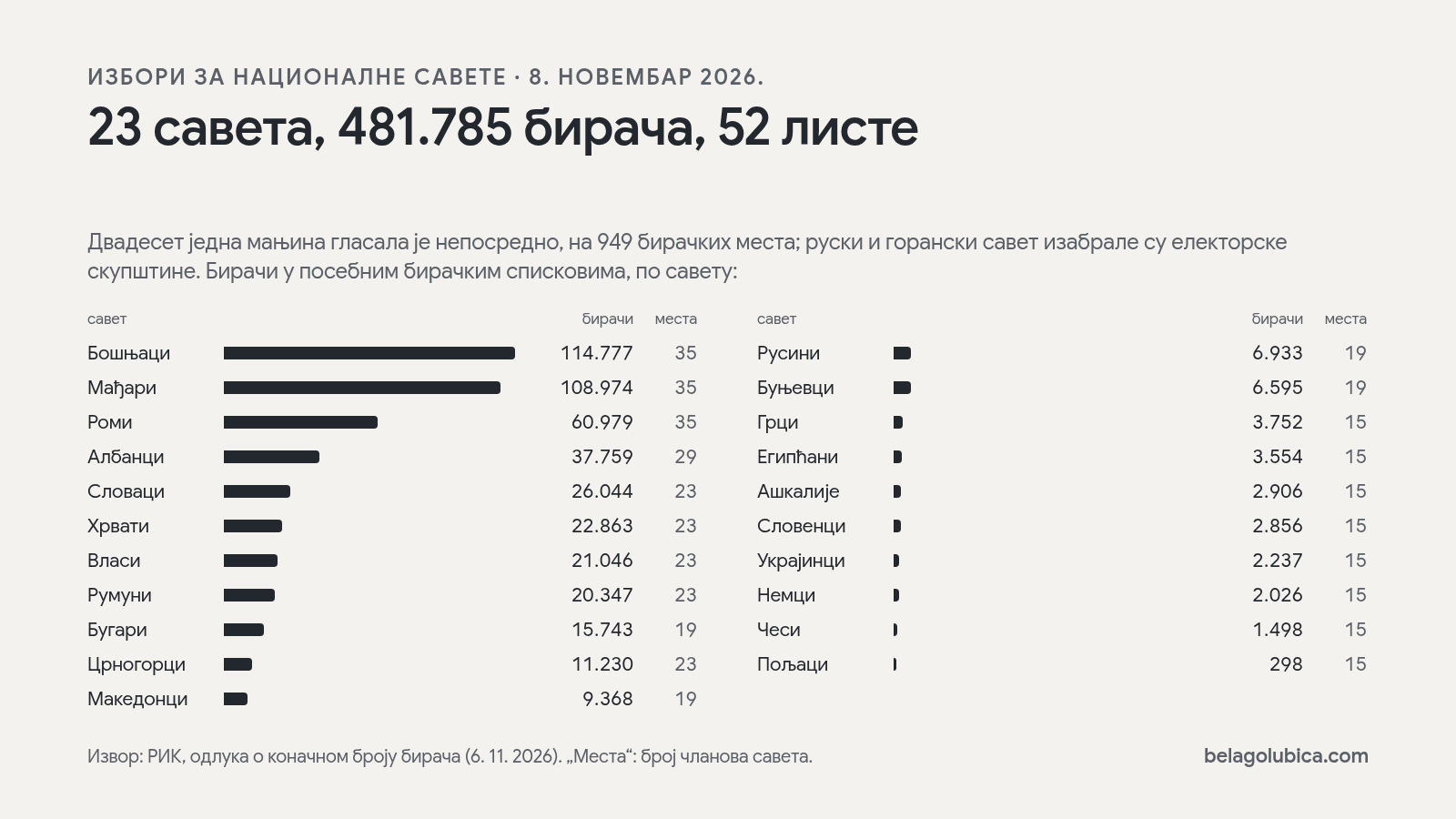
On Sunday, 8 November, from 7 am to 8 pm, members of 21 national minorities elected the members of their national councils at 949 polling stations across Serbia. 481,785 voters on the special voter lists had the right to vote, and there were 52 electoral lists on the ballots (RTS, Tanjug; the number of voters was set by the Republic Electoral Commission (RIK) at its 77th session on 6 November). The Russian and Gorani minorities elected their councils on the same day at electoral assemblies.
According to RIK member Dušan Dinčić, RIK will announce the preliminary results of the direct elections on Monday, 9 November, at 8 pm, at a session (N1, FoNet). The law requires the final results within 96 hours of the polls closing, so by 8 pm on Thursday, 12 November, at the latest. RIK has already published the polling boards' records as scans, one for every polling station and every council elected there: 5,152 records from all 949 stations, the first at 8:12 pm on Sunday and the last at 7:18 am on Monday (RIK, NSNM 2026 records).
Unofficial results from the records
RIK has not yet published results, but it has published the scanned polling board records from all 949 polling stations. White Dove read them automatically, with AI models, and added them up by council. A record counts only if its arithmetic adds up: the list votes add up to the valid ballots, and valid plus invalid ballots add up to the ballots in the box. In this way 5,032 of 5,149 records were read; the rest are not included, most often because the figures on the paper itself do not add up or the table is empty. We checked a sample of records with the strongest model as well, and the figures matched. The seats are calculated by law, using the D'Hondt method without a threshold. These are not RIK results: RIK announces the preliminary results tonight at 8 pm, and they take precedence. As of 12:15; the same figures, with a chart of the seats for every council, are on the Results page:
- Bosniak (35 seats; ballots cast 32,867, 354 of 361 records): Čuvari Sandžaka 14,334 (44.1%) – 16 seats; Sandžačka demokratska partija – Elmir Habibović 11,249 (34.6%) – 12 seats; Usame Zukorlić – Pokret za ujedinjenje Bošnjaka 6,491 (20.0%) – 7 seats; Ujedinjeni Bošnjaci – Samir Tandir 454 (1.4%) – 0 seats.
- Hungarian (35 seats; ballots cast 38,499, 438 of 444 records): Mađarska sloga 27,099 (71.1%) – 25 seats; Pokret za novi početak vojvođanskih Mađara 11,006 (28.9%) – 10 seats.
- Roma (35 seats): Ujedinjeni Romi za ujedinjenu Srbiju – Dejan Vlajković, 6,081 votes and every seat; ballots cast 6,176, 592 of 607 records.
- Albanian (29 seats; ballots cast 14,005, 147 of 152 records): Partija za demokratsko delovanje 4,653 (33.5%) – 10 seats; Pokret za demokratski progres – Šćiprim Musliu 4,075 (29.3%) – 8 seats; Alternativa za promene – Levent Ćazimi 2,810 (20.2%) – 6 seats; Demokratska partija – Sali Salihi 2,367 (17.0%) – 5 seats.
- Slovak (23 seats; ballots cast 5,198, 225 of 236 records): Služimo samo slovačkom narodu – Matica slovačka u Srbiji – Juraj Červenak 4,154 (80.6%) – 19 seats; Slovaci zajedno! 997 (19.4%) – 4 seats.
- Croatian (23 seats; ballots cast 7,884, 386 of 394 records): HNV – Hrvatska nacionalna vizija – Jasna Vojnić 5,186 (66.9%) – 16 seats; Složno za HNV 1,510 (19.5%) – 4 seats; Savez Hrvata Vojvodine – Sve po planu 2026 1,057 (13.6%) – 3 seats.
- Vlach (23 seats): Ujedinjeni Vlasi za ujedinjenu Srbiju, 3,042 votes and every seat; ballots cast 3,097, 181 of 189 records.
- Romanian (23 seats; ballots cast 5,074, 323 of 327 records): Rumuni zajedno – Idemo napred! 2,857 (58.3%) – 13 seats; Rumunska partija – Rumuni pobeđuju – dr Jon Sfera 2,043 (41.7%) – 10 seats.
- Bulgarian (19 seats; ballots cast 6,558, 318 of 326 records): To smo mi – Prirodni pokret – Vladimir Zaharijev 3,047 (47.7%) – 9 seats; Naš narod, naš glas, naša budućnost – Partija Bugara Srbije 1,938 (30.3%) – 6 seats; Demokratska partija Bugara – Nebojša Ivanov 1,407 (22.0%) – 4 seats.
- Montenegrin (23 seats; ballots cast 2,031, 304 of 311 records): Crnogorski elektori Srbije 1,328 (67.2%) – 16 seats; Dragoljub Malović – Jedinstveni 649 (32.8%) – 7 seats.
- Macedonian (19 seats; ballots cast 2,774, 269 of 271 records): Makedonci zajedno 1,292 (47.1%) – 9 seats; Za Makedonce pre svega 687 (25.0%) – 5 seats; Demokratska partija Makedonaca 572 (20.8%) – 4 seats; Makedonci u Srbiji 193 (7.0%) – 1 seat.
- Rusyn (19 seats; ballots cast 3,018, 180 of 184 records): Na talasu promena 1,970 (65.6%) – 13 seats; Rusini zajedno 509 (16.9%) – 3 seats; Iskreno za Rusinke i Rusine – prof. dr Mihajlo Fejsa 435 (14.5%) – 3 seats; Muzika Rusini – Slavko Roman Rondo 91 (3.0%) – 0 seats.
- Bunjevac (19 seats; ballots cast 1,786, 197 of 201 records): Dr Suzana Kujundžić Ostojić – Nek se znade, da Bunjevac živi! 829 (47.2%) – 9 seats; Bunjevci ujedinjeno za Srbiju 707 (40.3%) – 8 seats; Bunjevci za svoj identitet – Savez bačkih Bunjevaca 220 (12.5%) – 2 seats.
- Greek (15 seats; ballots cast 723, 189 of 195 records): Grci zajedno – Petar Rodifcis Nađ 299 (42.0%) – 7 seats; Ujedinjeni Grci za ujedinjenu Srbiju 209 (29.4%) – 4 seats; Grci zajedno – Srcem za Srbiju! 204 (28.7%) – 4 seats.
- Egyptian (15 seats): Egipćani Srbije – Bajram Kruezi, 285 votes and every seat; ballots cast 285, 99 of 103 records.
- Ashkali (15 seats; ballots cast 532, 119 of 121 records): Ujedinjene Aškalije za Srbiju – Emini Aziz 187 (35.6%) – 6 seats; Muhamet Behrami – Za napredak Aškalija 119 (22.6%) – 3 seats; Aškalije, ali zajedno – Iljaz Ramadanović 103 (19.6%) – 3 seats; Ajnur Toplica – Naš glas, naša budućnost 96 (18.3%) – 3 seats; Za pobedu Aškalija – Erdelj Herinckh 21 (4.0%) – 0 seats.
- Slovene (15 seats): Slovenci zajedno, 673 votes and every seat; ballots cast 691, 189 of 197 records.
- Ukrainian (15 seats; ballots cast 680, 132 of 134 records): Grupa birača „Senjuk“ – Filip Pronek 372 (55.1%) – 8 seats; Ujedinjeni – Sremska Mitrovica, Novi Sad, Inđija, Vrbas, Kula 303 (44.9%) – 7 seats.
- German (15 seats): Zajednička lista podunavskih Nemaca, 562 votes and every seat; ballots cast 570, 240 of 244 records.
- Czech (15 seats; ballots cast 682, 103 of 104 records): Češka lista 363 (54.0%) – 8 seats; Česi pobeđuju! 164 (24.4%) – 4 seats; Česi zajedno 145 (21.6%) – 3 seats.
- Polish (15 seats): Poljska sloga, 114 votes and every seat; ballots cast 115, 47 of 48 records.
Why this is not one election but 23
These elections are nothing like the parliamentary elections of 25 October. Each minority elects its own council, so this is really 23 separate elections on the same day.
- Only voters on the special voter list can vote. A member of a minority votes if they are on their minority's special voter list. Registration is by personal request only, and on one special list only (Articles 47 and 52 of the Law on National Councils of National Minorities).
- Each minority has its own lists and its own council size. A council has 15, 19, 23, 29 or 35 members, depending on the size of the minority at the last census (Article 9). The Bosniak, Hungarian and Roma councils have 35 members each, the Albanian 29, and the German, Polish or Czech 15 each.
- One polling station, several elections. The same polling station often serves several councils: the ballots of all minorities go into the same box, and after the count the polling board writes a separate record for each council. Dinčić gave the example of a polling station in Kragujevac with voter list extracts for 17 minorities, and therefore 17 records. That is why processing takes longer than at parliamentary elections, and why RIK did not publish turnout during the day.
- Direct vote or electors. Direct elections are held when more than 40% of the minority's members, by the census, are on the special voter list (Article 29); otherwise an electoral assembly elects the council. According to RTS, the Croatian minority is electing its council directly for the first time this year.
- Seats without a threshold. Seats are allocated by the largest quotient (D'Hondt) method: each list's votes are divided by 1, 2, 3…, and the largest quotients win the seats. If two lists have the same quotient for the last seat, the list with more votes gets it. A list cannot win more seats than it has candidates, so such a seat goes to the next largest quotient (Article 98). This is not just theory: on the Ashkali ballot, for 15 seats, the list "For the Victory of the Ashkali – Erdelj Herinckh" has six candidates and "Ashkali, but Together – Iljaz Ramadanović" nine.
Who is being elected and how many voters there are
The number of voters per council, by RIK's decision of 6 November, with the number of council members and the number of lists on the ballot (RTV; lists from the RIK website):
- Bosniak council: 114,777 voters, 35 members, 4 lists
- Hungarian: 108,974 voters, 35 members, 2 lists
- Roma: 60,979 voters, 35 members, 1 list
- Albanian: 37,759 voters, 29 members, 4 lists
- Slovak: 26,044 voters, 23 members, 2 lists
- Croatian: 22,863 voters, 23 members, 3 lists
- Vlach: 21,046 voters, 23 members, 1 list
- Romanian: 20,347 voters, 23 members, 2 lists
- Bulgarian: 15,743 voters, 19 members, 3 lists
- Montenegrin: 11,230 voters, 23 members, 2 lists
- Macedonian: 9,368 voters, 19 members, 4 lists
- Rusyn: 6,933 voters, 19 members, 4 lists
- Bunjevac: 6,595 voters, 19 members, 3 lists
- Greek: 3,752 voters, 15 members, 3 lists
- Egyptian: 3,554 voters, 15 members, 1 list
- Ashkali: 2,906 voters, 15 members, 5 lists
- Slovene: 2,856 voters, 15 members, 1 list
- Ukrainian: 2,237 voters, 15 members, 2 lists
- German: 2,026 voters, 15 members, 1 list
- Czech: 1,498 voters, 15 members, 3 lists
- Polish: 298 voters, 15 members, 1 list
In six councils, the Vlach, Egyptian, German, Polish, Roma and Slovene, there was only one list on the ballot. By law it wins every seat, so the only open question there is how many voters turned out.
What is already known
Electoral assemblies. The Russian and Gorani councils were elected on Sunday at noon, at electoral assemblies in the National Assembly building. Thirty electors voted unanimously for the list of the National Council of the Russian National Minority led by Milovan Ćurčić, electing all 19 members. Twenty-one electors voted unanimously for the Gorani council list led by Amir Kajkuš, electing all 15 members (RIK).
Direct elections, so far only from the lists. Some lists announced their own figures during the night. These are not RIK results (RTS):
- "Hungarian Unity" (Magyar Összefogás), backed by the Alliance of Vojvodina Hungarians, estimates that it will hold 25 of the 35 seats on the Hungarian National Council and that about 40% of registered voters turned out, more than four years ago. The other list on the ballot is the "Movement for a New Beginning of Vojvodina Hungarians".
- Jasna Vojnić, who heads the list "HNV – Croatian National Vision", said that with 80% of polling stations processed the list has about 4,500 votes and 16 of 23 seats, "Together for HNV" four and the "Alliance of Vojvodina Croats" three. By those figures 7,400 of 22,793 registered voters turned out (RIK set the number of voters for the Croatian council at 22,863).
- For the Bosniak National Council, RTS reported preliminary results giving "Guardians of Sandžak" 42.8% of the vote, "Sandžak Democratic Party – Elmir Habibović" 34.7%, "Movement for the Unification of Bosniaks – Usame Zukorlić" 19.9% and "United Bosniaks – Samir Tandir" 2.5%. Fuad Baćićanin of the "Guardians of Sandžak" list declared victory.
What comes next
- Monday, 9 November, 8 pm: preliminary results at a RIK session.
- By 8 pm on Thursday, 12 November, at the latest: the report with the total results for each council, which RIK publishes in the Official Gazette (Article 97a).
- Within three days of the final results: RIK allocates the seats by decision, to candidates in the order of the list (Article 98). A council's term lasts four years from its constitution (Article 9a).
What White Dove will do
Follow the results for each council, with a chart of the seats for every council, on the Results page, in the "National councils 2026 – RIK" view. When RIK publishes the preliminary and then the final results, they will replace the sum of the records there, and we will update this story.
Note: Usame Zukorlić, after whom one of the lists for the Bosniak National Council is named, led the list of the Party of Justice and Reconciliation (SPP) in the elections of 25 October, when SPP tracked polling station records through White Dove (we wrote about it). White Dove did not track records for any list in the national council elections. The figures on voters, lists and electoral assemblies come from RIK's acts; the figures from the direct elections are unofficial, and we report them as statements by the lists and media reports.