Bela golubica2 views
RIK has finished its work: seats assigned, report goes to the Assembly. What comes next and by when
At three sessions on 5 and 6 November, RIK adopted the total report on the results, assigned the 250 seats and adopted the report on the conduct of the election, completing its work on the 25 October vote. Next come the first session of the Assembly by 5 December, a new Government within 90 days of its constitution, and a presidential election by 27 December, to be called by 27 November.
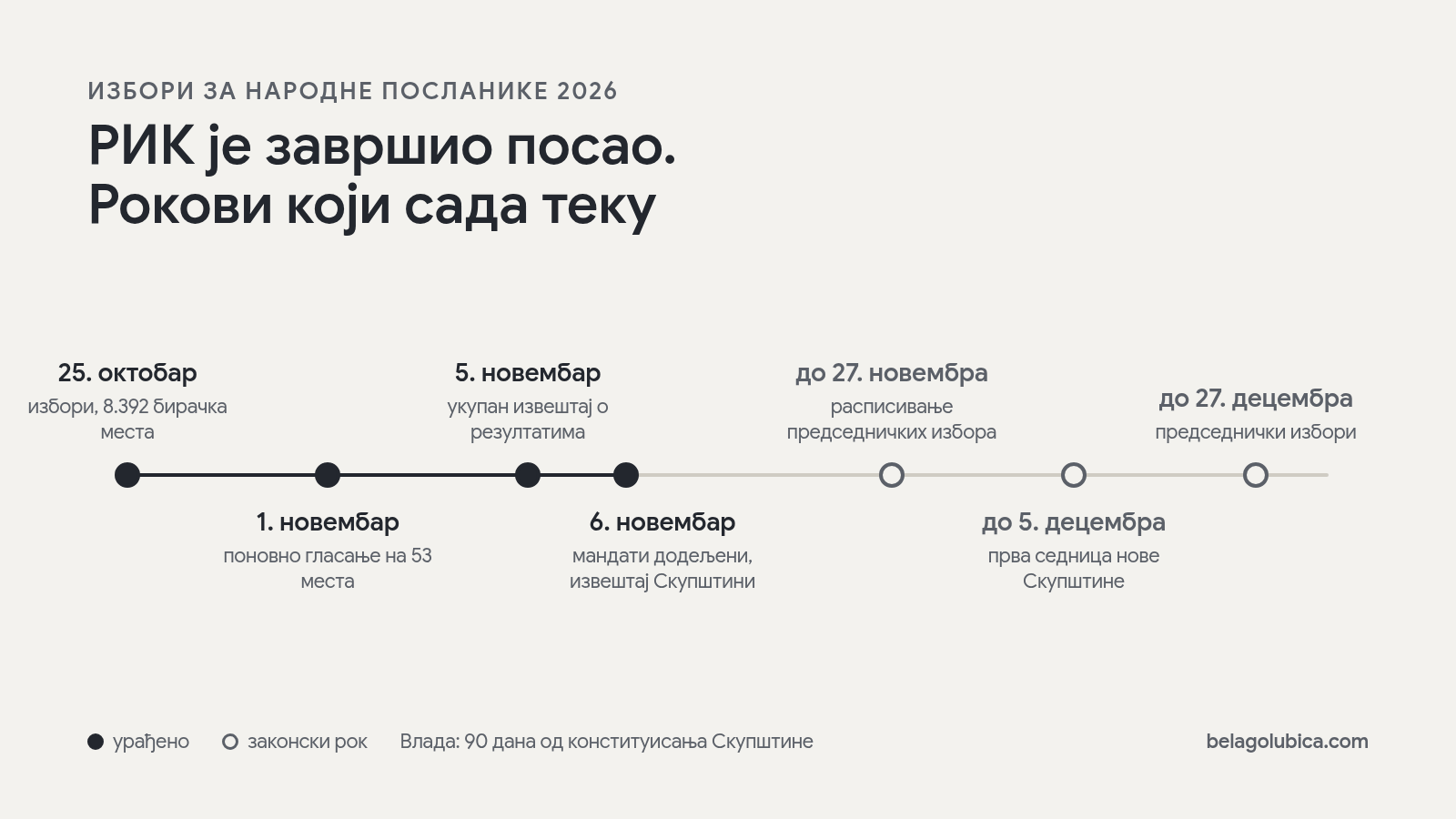
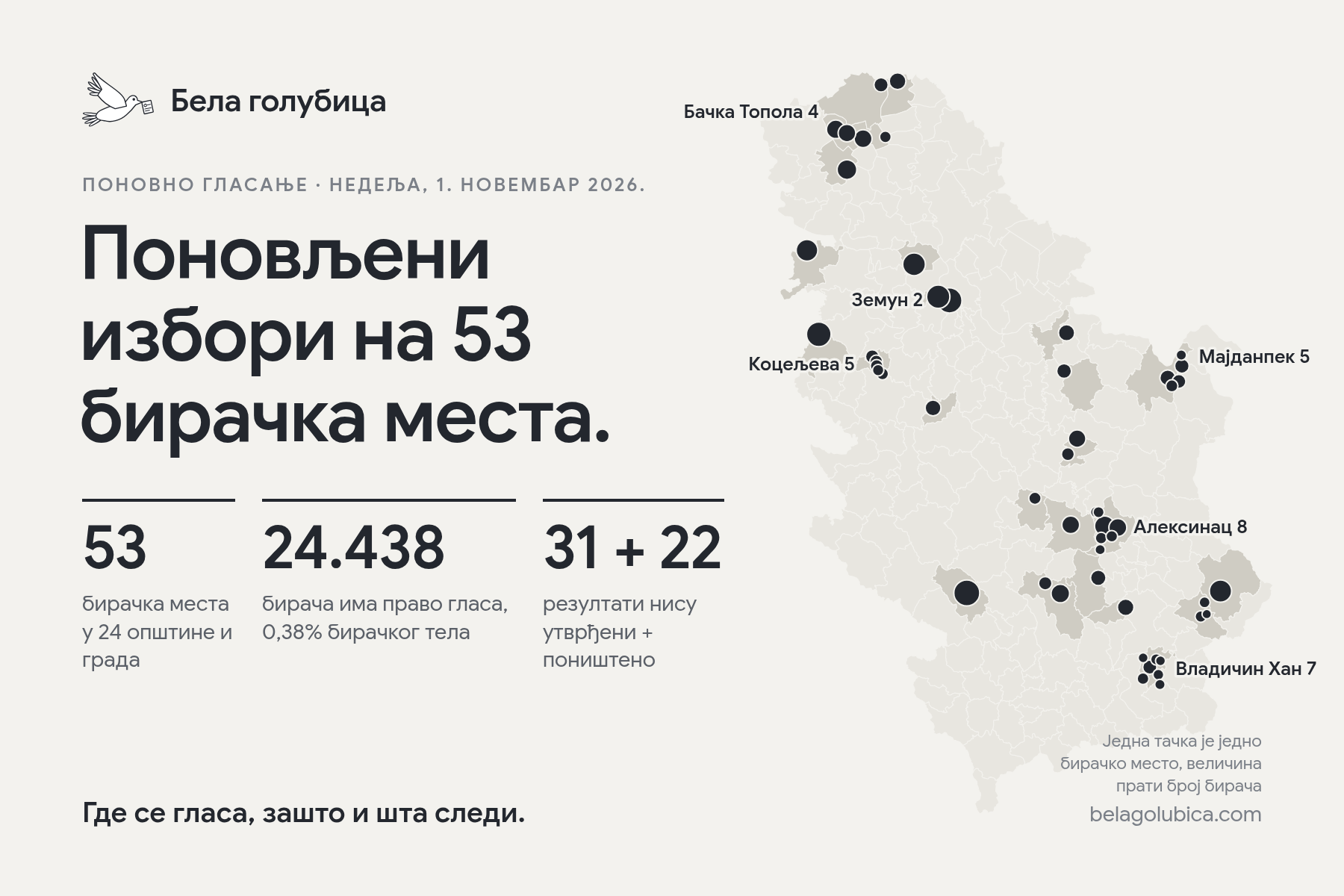
On Thursday and Friday, 5 and 6 November, the Republic Electoral Commission (RIK) completed everything the law requires of it after the parliamentary election of 25 October and the repeat vote at 53 polling stations on 1 November. At its 75th session it adopted the total report on the election results, at the 76th the decision assigning the seats, and at the 78th the report on the conduct of the election, which it submits to the National Assembly. RIK president Vladimir Dimitrijević said this ended the Commission's jurisdiction over this election (RTV).
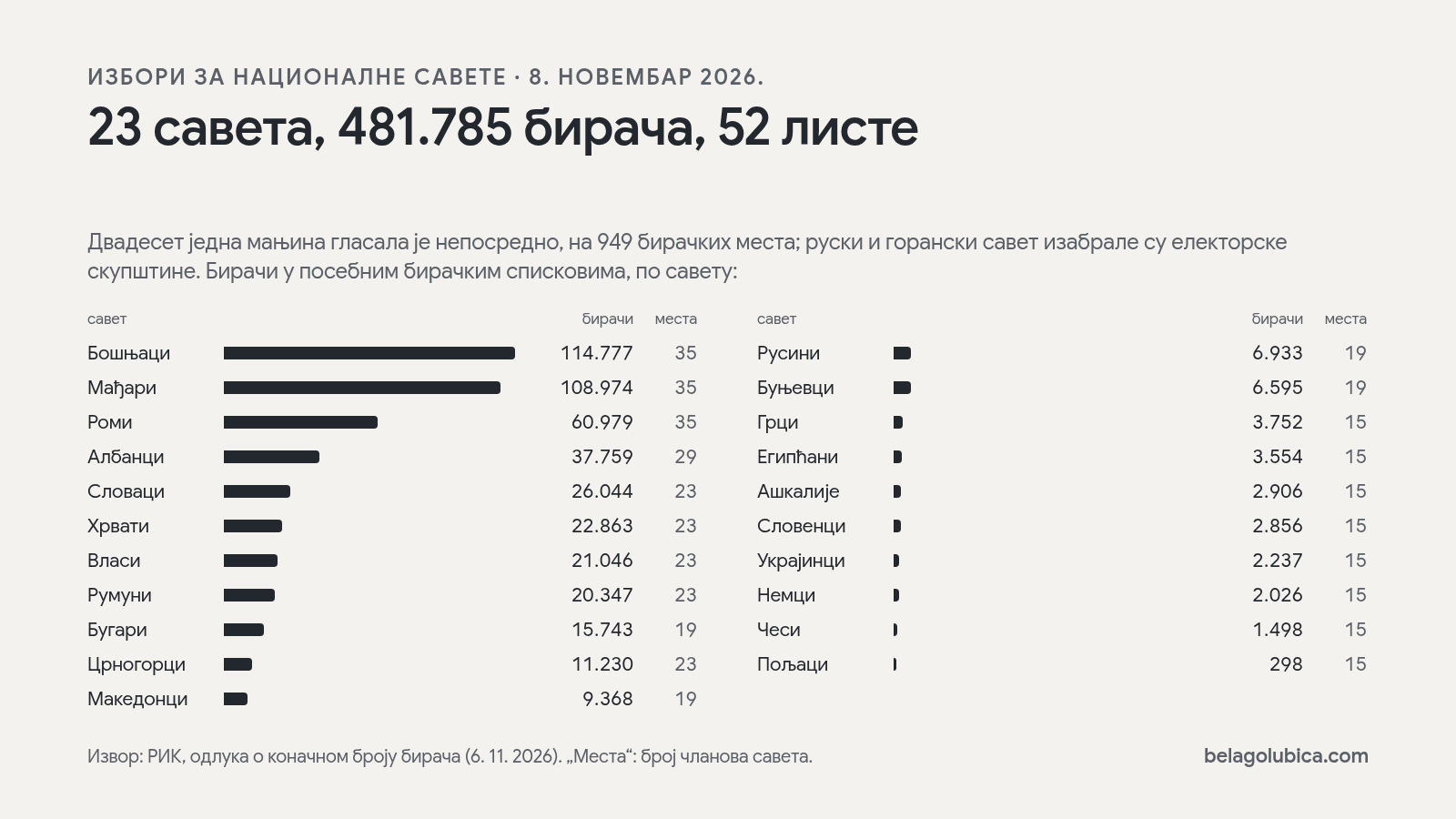
In between, the 77th session dealt with the elections for the national councils of national minorities, held on Sunday 8 November: RIK set the final number of voters, 481,785, and the number of ballots (Tanjug). Those elections are not part of this story.
Everything moved faster than the deadlines we wrote about on 2 November: the total report came four days before the latest date we estimated then, and the seats were assigned the very next day, although RIK had ten days for that.
What RIK established
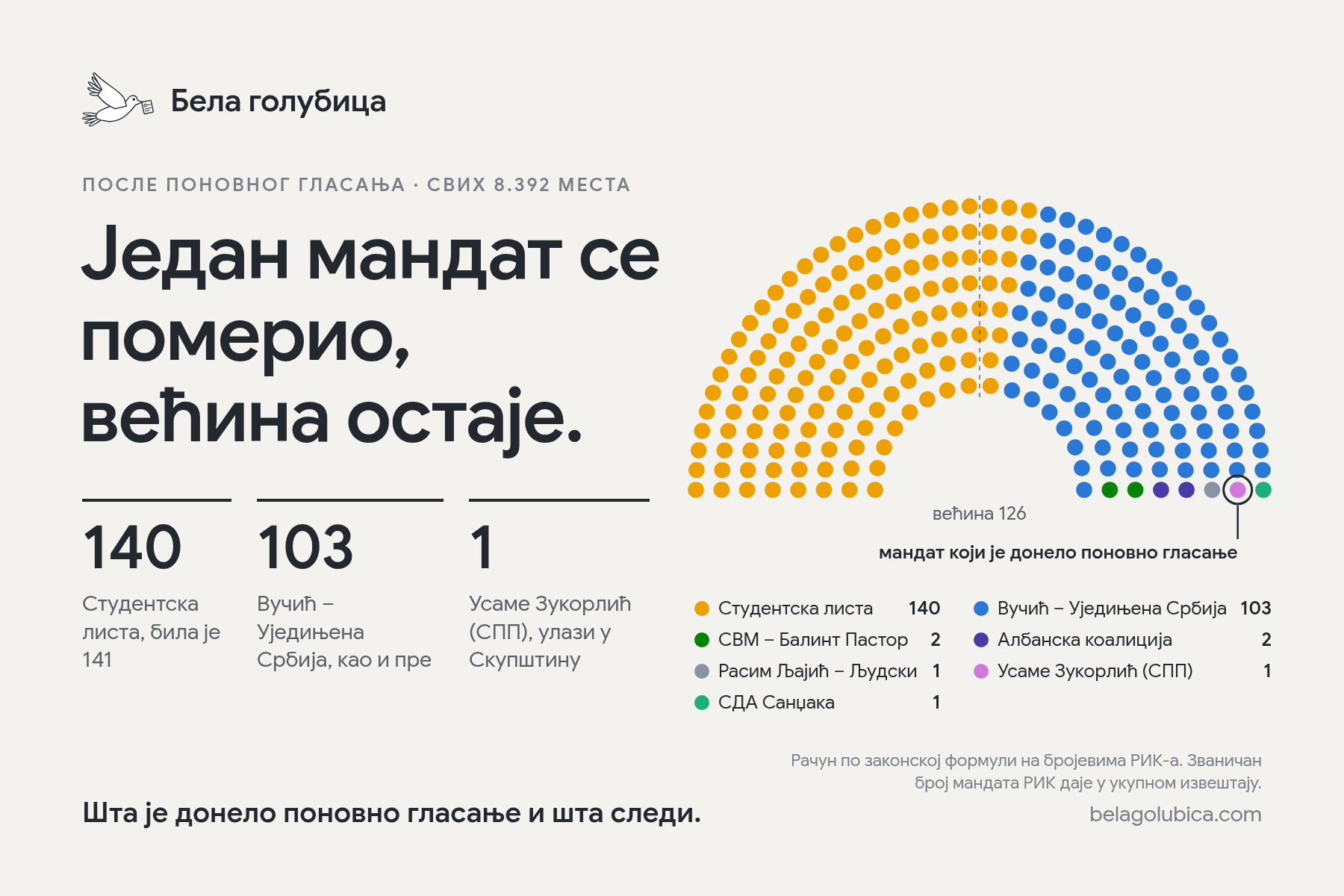
The total report confirms the figures we published on 2 November. At 8,392 polling stations, 4,444,310 of the 6,451,292 registered voters voted, a turnout of 68.89%. The ballot boxes held 4,441,636 ballots, of which 4,385,065 were valid and 56,571 invalid. The seats:
- Student List – Students Win: 140 seats (2,354,417 votes)
- Aleksandar Vučić – United Serbia: 103 (1,731,323)
- Alliance of Vojvodina Hungarians – Dr Bálint Pásztor: 2 (35,461)
- Albanian Coalition: 2 (27,683)
- Rasim Ljajić – Humane (SDP – CDP): 1 (20,638)
- SDA of Sandžak – Guardians of Sandžak: 1 (12,596)
- Usame Zukorlić (SPP) – Movement for Unification: 1 (12,440)
Of the 18 lists on the ballot, 11 won no seat. The strongest among them was Ivica Dačić – Factor of Stability, with 94,766 votes, below the threshold of 3% of the voters who voted.
The report was adopted unanimously (RTS). RIK member Ivan Šebek voiced doubts at the session about the repeat-vote results at several stations, among them in Aleksinac and at station 81 in Novi Pazar, and called on prosecutors and the police to look into possible vote buying. Enes Mahmutović, the representative of the Party of Justice and Reconciliation (SPP) in RIK, replied that he saw nothing disputable in the result and that legal remedies exist for such doubts. We covered the Aleksinac allegations and the figures from those stations earlier.
Three acts, three roles
The three acts play different roles under the Law on the Election of Members of Parliament (text of the law):
- The total report on the election results is the final result. It is published in the Official Gazette (Article 122). A list submitter and any voter may file an objection with RIK within 72 hours of its publication on RIK's website (Article 121), and appeal RIK's ruling to the Administrative Court within a further 72 hours; the court decides within 72 hours of receiving the appeal and its decision is final (Articles 156–158).
- The decision assigning the seats determines who the MPs are: RIK assigns the seats to the candidates in the order on the list, starting with the first, and issues them certificates of election (Article 130). The deadline was ten days from publication of the total report.
- The report on the conduct of the election is submitted by RIK to the National Assembly (Article 24). On the basis of that report and the certificates, the new convocation verifies the mandates at its first session.
The first session of the Assembly: by 5 December
The first session of the new convocation is convened by the Speaker of the outgoing Assembly, so that it is held no later than 30 days after the proclamation of the final results (Article 101 of the Constitution). Counted from 5 November, when RIK adopted the total report, that is Saturday, 5 December at the latest. Ana Brnabić said on 2 November that she would convene the session "as soon as possible" once RIK proclaimed the results (Vranjska plus), and the caretaker government said on 6 November that it expected the Assembly to be constituted "in the shortest possible time" (RTS). No date has been announced yet.
What happens at the first session, under the Constitution, the Law on the National Assembly and the Rules of Procedure:
- Until a Speaker is elected, the session is chaired by the oldest MP.
- The Assembly verifies the mandates on the basis of RIK's report and the certificates of election. The decision on verification can be appealed to the Constitutional Court, which rules within 72 hours (Article 101).
- The convocation is constituted once the mandates of two thirds of the MPs, at least 167, have been verified. On that day the mandate of the previous convocation ends and the new MPs' four-year term begins (Article 102). The MPs then take the oath.
- A Speaker is elected, on a proposal by at least 30 MPs and by a majority of all MPs, at least 126 (Article 104 of the Constitution, Article 20 of the Law on the National Assembly), followed by the deputy speakers and the Secretary General.
The new Speaker will also be acting President
Aleksandar Vučić resigned as President of the Republic on 27 September in order to lead a list in the election. Since then, under Article 120 of the Constitution, the Speaker of the National Assembly stands in for him, for at most three months. The substitution is attached to the office, not the person: when the new convocation elects its Speaker, that person also takes over as acting President. Brnabić said as much on 30 October: if the institutions are formed quickly, "someone else will take over the office of acting President of the Republic" (Novosti, Tanjug).
The acting President thus has two key duties in the coming weeks: to propose a candidate for Prime Minister to the Assembly, and to call the presidential election.
The Government: 90 days from constitution
The candidate for Prime Minister is proposed by the President of the Republic, or the acting President, after hearing the representatives of the elected lists (Articles 112 and 127 of the Constitution). The candidate presents a programme to the Assembly and proposes the composition of the Government, which is voted on as a whole. The Government is elected if a majority of all MPs, at least 126, votes for it, and its term begins when it takes the oath (Article 128). The Student List, with 140 seats, has that majority on its own.
If the Assembly fails to elect a Government within 90 days of being constituted, it is dissolved and new elections are called (Article 109). If the convocation is constituted in early December, that deadline runs out in early March 2027. Until a new Government is elected, the outgoing caretaker government carries on.
The presidential election: by 27 December
Under Article 120 of the Constitution, the presidential election must be held no later than three months after the end of the President's term, which, counted from 27 September, is 27 December, a Sunday (Vreme). The election is called by the Speaker of the National Assembly, and no fewer than 30 and no more than 60 days may pass between the calling and the vote (Law on the Election of the President of the Republic, Articles 9 and 10). The last day to call it is therefore 27 November. Brnabić confirmed both dates on 30 October: "In line with the Constitution of the Republic of Serbia, the election will be held by 27 December", and the deadline for calling it is 27 November.
Once it is called, the deadlines are short: candidacies are filed with RIK no later than 20 days before voting day (Article 13), and RIK publishes the list of candidates no later than 15 days before the vote (Article 17). The winner of the first round is the candidate with a majority of the votes of those who voted; if there is none, the top two go to a second round within 15 days of RIK's decision (Articles 21–23).
What White Dove will do
The Results page remains available with all the figures from the 8,392 polling stations, the scanned protocols and the diagram of the Assembly. We will report on the first session, the election of the Government and the presidential election once they are scheduled.
Note: the Party of Justice and Reconciliation, whose representative in RIK is mentioned in this article, used White Dove to track the protocols in the election of 25 October (we wrote about it). All figures in this article come from RIK's acts, and the deadlines from the Constitution and the laws we link to.